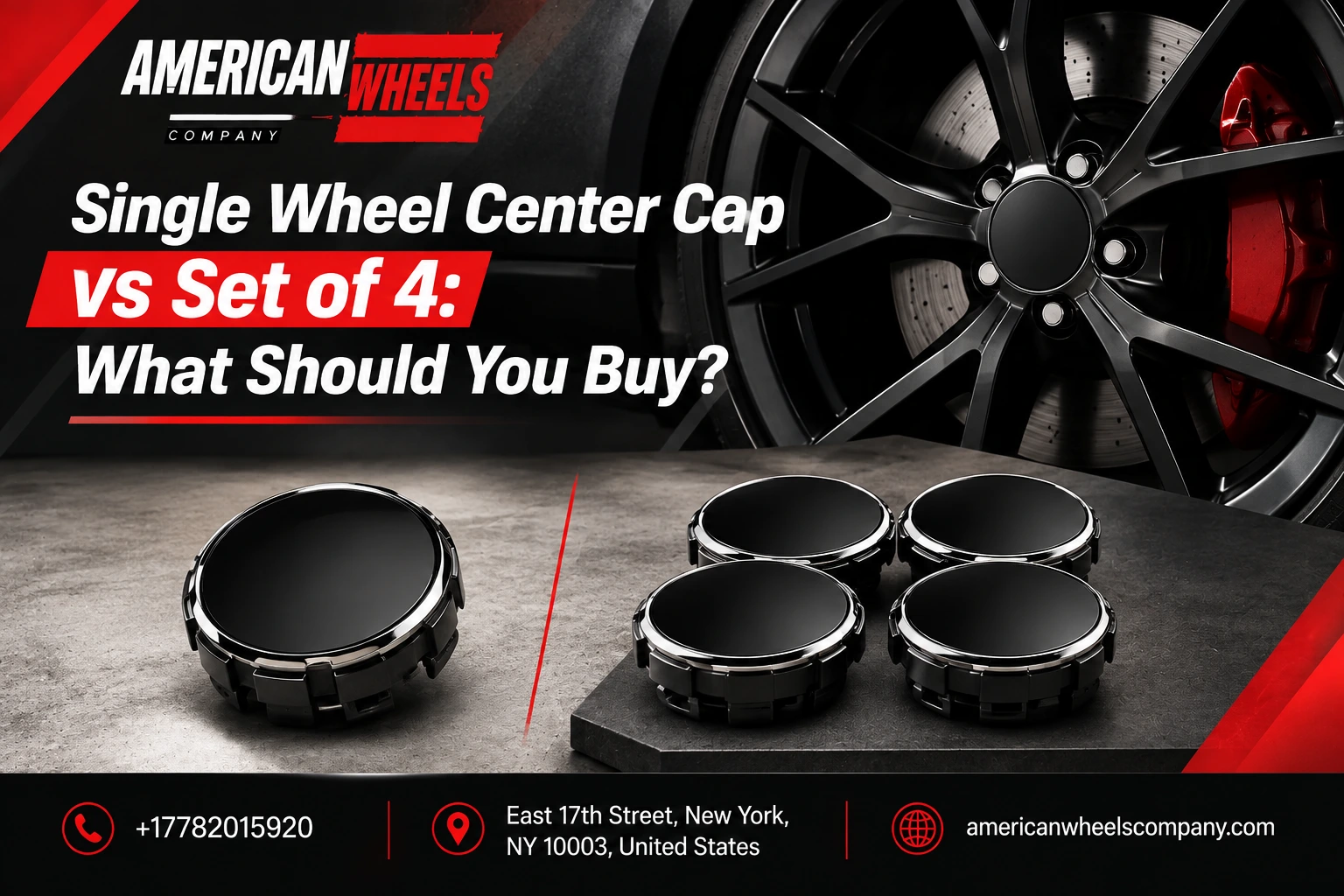
Wheel center caps set of 4 are not always the right choice. If only one cap is missing or damaged and the other three are still in good shape, buying a single wheels center cap usually makes more sense. But if several caps are damaged, faded, loose, or you want all four wheels to match, a set of 4 is often the better option.
The key is not simply choosing between one and four. You need to match the wheel, cap size, mounting style, finish, and quantity before you order. Here is how to make the right choice without wasting money on caps you do not need.
American Wheels Company offers replacement and aftermarket options for different wheel applications, but the same fitment rule applies no matter where you buy: match the cap to the wheel, not just the vehicle.
When Should You Buy a Single Wheel Center Cap?
Buying one is usually the simplest option when the problem is limited to one wheel.
Only One Center Cap Is Missing
If three caps are still installed and look good, there is little reason to replace all four. Find a replacement that matches the existing caps in:
Size
Wheel application
Logo
Finish
Color
Mounting style
Part number, when available
This is especially useful when one cap was lost on the road or during tire service.
Before ordering, check whether the listing is actually sold as one cap. Product photos are not always enough to tell you the quantity.
One Cap Is Cracked or Damaged
A cracked center cap does not automatically mean you need a full set. If the other three are still strong and match, replace the damaged one.
Look at the back of the damaged cap, too. Broken clips, a damaged retaining ring, or worn mounting points are signs that the cap itself needs replacement.
The Other Three Caps Still Look Good
This is one of the strongest reasons to buy a single replacement.
If the other three have:
Similar finish
No cracks
Good retaining clips
No loose fit
No major fading
then a matching single cap is usually the practical choice.
A full set makes more sense when the problem affects more than one wheel.
Several Caps Are Damaged
If two, three, or all four caps are cracked or loose, buying individual replacements one at a time can become frustrating.
A matched set gives you four caps designed for the same application. You still need to confirm the exact fitment before ordering.
All Four Caps Are Faded or Worn
This is often an appearance issue. Imagine three old caps with faded finishes and one brand-new glossy cap. The new cap might be correct, but the wheel set can still look uneven.
In this situation, a set of 4 wheel center caps gives all four wheels a consistent appearance.
You Want a New Logo or Finish
If you are changing from one logo style to another, replacing only one cap usually does not make sense.
A full set gives you the same:
Logo
Color
Finish
Design
Size
Mounting system
across all four wheels. That creates a much cleaner look.
You Have a New Wheel Setup
If you are fitting caps to a new set of wheels, buying four matching caps is normally the easiest route. Just remember that four caps being sold together does not mean they will fit every wheel.
The wheel brand, model, part number, dimensions, and mounting system still matter.
Wheel Center Caps Set of 4 vs Single: Pros and Cons
Feature
Single Center Cap
Set of 4
Quantity
1 cap
4 caps
Best for
One lost or damaged cap
Multiple replacements
Matching appearance
Depends on old caps
Easy to keep consistent
Extra caps
No
Yes
Waste
Less if you need only one
More if three caps are still good
Good for full wheel refresh
No
Yes
Good for one replacement
Yes
Not usually necessary
Spare available
No
You have extras
Fitment check
Still required
Still required
Neither option is automatically better. The right choice depends on how many caps you actually need and the condition of the other three.
Is a Set of 4 Always the Better Deal?
No. A 4-pack can be a better value when you need several caps, but buying four does not automatically save you money or make sense.
Some retailers list center caps individually and also show a set-of-4 option. For example, Tire Rack product listings clearly show individual replacement caps alongside a set-of-4 quantity.
The better purchase is the one that solves your actual problem. If you need one cap, paying for three extras you do not need is not necessarily a better deal.
If you need all four, buying a matched set can be much more convenient.
Will All 4 Center Caps Fit My Wheels?
Not necessarily. This is where many buyers make an expensive mistake. A set of four only tells you the quantity. It does not prove that the caps fit your wheels.
Before buying, check:
Wheel brand
Wheel model or series
Part number
Outer diameter
Mounting diameter
Cap depth
Retaining clips
Tension ring
Snap-in or bolt-on design
Push-through mounting, if applicable
Logo and finish
Two caps can look almost identical from the front but have different mounting dimensions on the back. The same is true for size. A 68mm cap from one wheel does not automatically fit every 68mm application.
American Wheels Company’s current size guide points out that mounting diameter, depth, clips, and attachment style can change fitment even when the visible size is similar.
If you are checking sizes such as 54mm, 56mm, 60mm, 68mm, or 75mm, use the center cap measurements and common sizes as a starting point rather than treating the number as a universal fit.
How Many Wheel Center Caps Do You Actually Need?
The answer is simpler than it sounds.
Need 1? Buy 1.
If one cap is missing and the other three are in good condition, look for one matching replacement.
Need 2 or 3? Compare Both Options
If multiple caps are damaged, compare the cost and availability of individual caps with a four-piece set.
Also consider whether the remaining caps are likely to fail soon.
If they are already cracked, loose, or badly faded, replacing all four at once can save you from repeating the job.
Need 4? Buy a Full Set
If all four caps are missing, damaged, or being replaced for a new look, a set of four is the obvious choice.
Want a Spare?
A set can also make sense when the exact cap is difficult to find.
If you find a verified match for a discontinued wheel, having an extra cap can be useful later.
Just make sure the listing actually contains four complete caps. Some products are sold individually, while others are pairs, assemblies, or four-packs. Current replacement guides also warn buyers not to assume quantity from the product photo alone.
What to Check Before Buying a Single or 4-Pack
Do not click Buy Now until you check these details.
1. Check the Part Number
If your old cap has a part number on the back, start there. A part number is often more useful than guessing from a photo.
2. Measure the Old Cap
If you still have the old cap, measure it carefully. Check more than the visible front diameter. The rear mounting area and depth also matter.
3. Compare the Backside
Turn the old cap over.
Look for:
Clips
Tabs
Rings
Holes
Screws
Notches
Mounting points
The backside often tells you more about fitment than the front.
4. Confirm the Quantity
Look for wording such as:
1 piece
Single
Pair
4-piece
Set of 4
Four-pack
Do not assume that a photo showing four caps means four are included.
5. Check the Finish and Logo
If you are replacing only one cap, the new one should match the other three as closely as possible.
Check:
Gloss
Matte
Chrome
Satin
Black
Logo
Emblem color
A technically correct cap that looks completely different can still be a poor replacement.
6. Check the Mounting Style
A snap-in cap and a push-through cap do not install the same way.
If you are installing a replacement yourself, make sure you know which style you have. For example, snap-in caps are normally pressed into the wheel from the front, while push-through caps are installed from the back.
Common Mistakes When Buying Center Caps
Assuming Every Center Cap Comes in a Set of 4
They do not. Some are sold individually, while others are offered in sets. Always read the quantity.
Buying a 4-Pack Just Because It Looks Better
If three of your caps are perfectly good, you might not need four new ones.
Buying by Vehicle Model Alone
Your vehicle information helps, but aftermarket wheels can use different center caps.
The wheel brand and model are often more important.
Ignoring the Part Number
If a part number is available, use it.
It can save you from guessing between similar-looking caps.
Buying Only One Without Checking the Other Three
Before buying a single cap, inspect the other three.
If all three are cracked or loose, you could end up buying four individual caps over time.
Choosing by Photo
A front photo does not show every measurement.
The rear mounting system is critical.
Ignoring Why a Cap Came Off
If the same wheel keeps losing its center cap, the problem might not be the cap.
Single or Set of 4? Use This Simple Decision Guide
Choose a single center cap when:
Only one is missing.
Only one is damaged.
The other three are in good condition.
You found an exact match.
The existing caps are not badly faded.
Choose a set of 4 when:
Several caps are damaged.
All four are faded.
You want a uniform appearance.
You are changing the logo or finish.
You are fitting caps to a new wheel setup.
You want verified matching spares.
The important thing is to solve the problem you actually have—not simply buy the largest quantity available.
How Do You Know the New Cap Will Stay in Place?
Correct fitment is only part of the job. The cap also needs to be installed correctly.
Before installation, clean dirt and debris from the wheel opening. Align the cap properly and press it evenly into place if it is a snap-in design. After installation, check that it sits flush and does not wobble.
A cap that feels loose should not be ignored. Recheck the size, mounting system, clips, and wheel opening before driving.
Conclusion : Single Cap or Set of 4?
If one wheel center cap is missing or damaged, and the other three are still in good shape, buy a single replacement.
If multiple caps are damaged, faded, loose, or you want a completely matching look, a set of 4 is usually the better choice.
But quantity should never come before fitment. A four-pack of the wrong center caps is still the wrong purchase.
Before ordering, confirm the wheel application, part number, measurements, mounting style, finish, and sold-as quantity. That small check can save you from returns, loose caps, and another replacement later.
For more options, you can browse replacement and custom center cap options based on your wheel application.
FAQs: Wheel center caps set of 4
Are wheel center caps sold individually?
Yes. Many replacement wheel center caps are sold individually, while some are offered as pairs or sets of four. Always check the product description and quantity before ordering. Tire Rack, for example, lists several replacement caps individually while also showing a set-of-4 option.
Do wheel center caps come in sets of 4?
Yes. Many retailers sell four-piece sets, but not every center cap is sold this way. Check the listing carefully to confirm whether you are getting one cap or four.
Should I buy one center cap or a set of 4?
Buy one if only one cap is missing or damaged and the other three are still in good condition. Buy a set of four when several caps are damaged, faded, or when you want all four wheels to match.
Can I replace just one wheel center cap?
Yes. You do not have to replace all four when only one cap needs replacement. The new cap should match the existing wheel application, size, mounting system, finish, and logo.
Do all four center caps have to be the same?
They do not have to be identical for the wheel to function, but matching caps usually give the cleanest appearance. If you are buying a new set, using four matching caps is normally the better choice.
How do I know if a 4-pack will fit my wheels?
Check the wheel brand, model, part number, cap dimensions, mounting diameter, depth, clips, and attachment style. Do not rely only on the vehicle year, make, and model or the front appearance of the cap.
What if my replacement center cap keeps falling off?
First check the fitment and installation. Inspect the clips, tension ring, and wheel-side mounting area. If the replacement is correct but keeps falling from the same wheel, the wheel itself may have a damaged or worn retaining area.