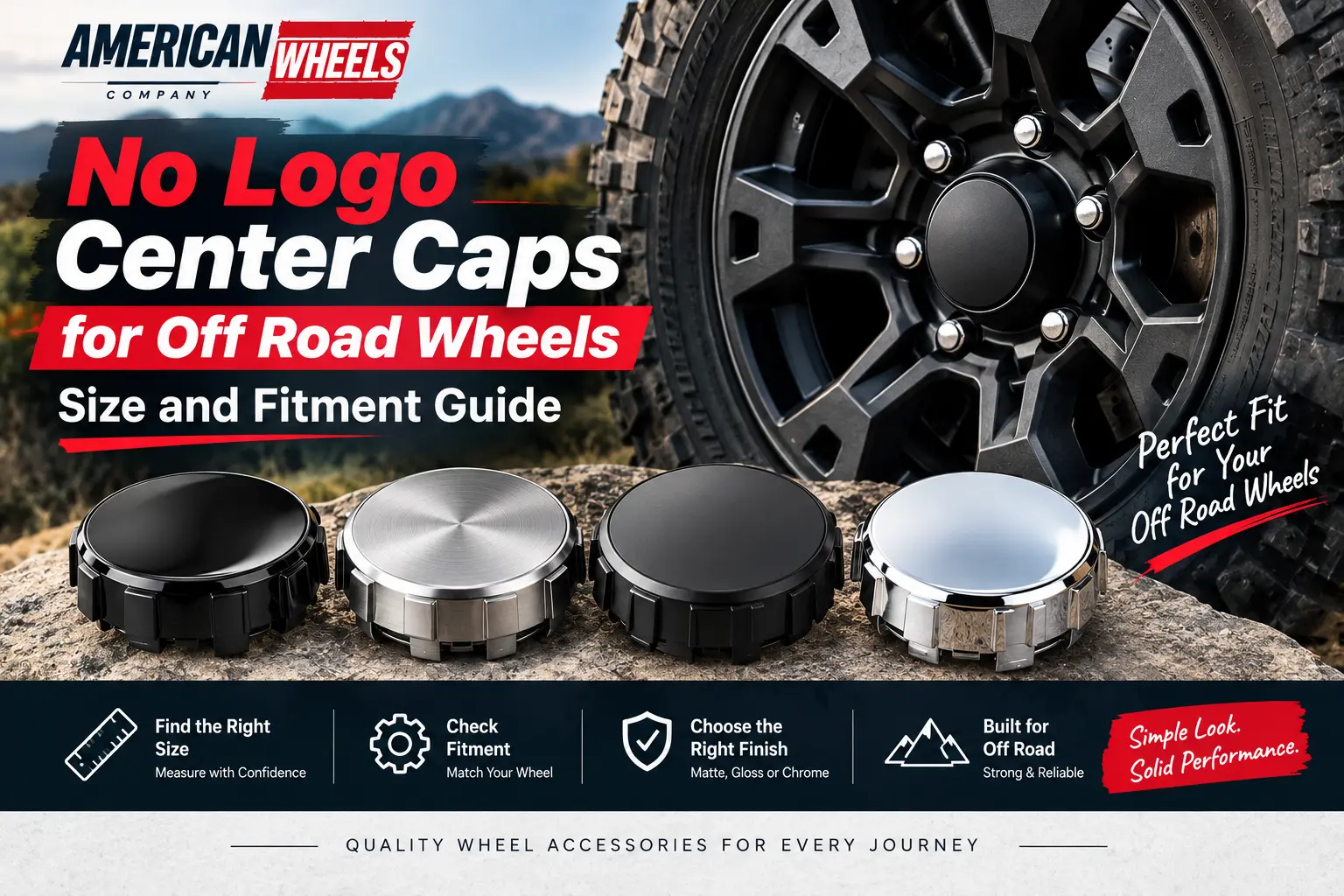
No logo center caps for off road wheels give your rims a clean, simple look without a vehicle or wheel-brand badge. To choose the right cap, you must match its outer diameter, rear mounting diameter, depth, and attachment style to your wheel. A blank cap is not automatically universal, so always check the measurements before ordering.
Whether you are replacing a missing cap, updating older wheels, or building a custom off-road setup, the right fit matters as much as the appearance. This guide explains how to measure your wheel, check compatibility, and choose a no-logo cap that fits securely.
You can compare available options from American Wheels Company and check the product specifications before placing an order.
What Are No Logo Center Caps for Off Road Wheels?
No-logo center caps are wheel caps with a plain front face and no visible vehicle or wheel-brand emblem. They cover the center opening of a compatible wheel and provide a clean, unbranded appearance.
They are often called blank center caps, plain wheel caps, or logo-free center caps. The exact names vary between sellers, so check the product photos and specifications rather than relying on the title alone.
Why Choose Blank Center Caps for Off-Road Wheels?
Off-road wheels often have a bold design, dark finish, or custom appearance. A plain center cap can keep the look simple without adding another logo to the wheel.
No-logo caps can be useful when:
Your original center cap is missing or damaged.
You prefer wheels without visible branding.
The original branded cap is no longer available.
You want to replace a faded or scratched cap.
You are building a custom wheel setup.
You want all four wheels to have a matching appearance.
A blank cap can also help cover the wheel’s center opening. However, its fit and construction must suit the specific wheel.
Are No-Logo and Universal Center Caps the Same?
No. No-logo describes the appearance, while universal describes the intended range of fitment.
A no-logo cap may be designed for one wheel model or a limited group of wheels. A product marketed as universal may fit several compatible wheel designs, but it still has size and mounting limits.
For example, American Wheels Company’s range of plain, unbranded wheel caps includes different sizes, finishes, and mounting styles. You must still match the selected product to your wheel.
How to Find the Right Off-Road Center Cap Size
Finding the correct size is easier when you have the old cap or can access the wheel’s center opening.
Step 1: Identify Your Wheel Brand and Model
Start by checking the wheel for a brand name, model, series, or part number. Look at the back of the wheel if the information is not visible on the front.
This information can help narrow down the available replacement options. If you know the exact wheel model, check the manufacturer’s replacement information before choosing a cap.
If you still have the original cap, remove it carefully and inspect the back.
Look for:
A part number or size marking
The shape and position of the retaining clips
The rear mounting diameter
The cap depth
Any screws, rings, or other mounting parts
A part number can make the search easier, but confirm that the replacement’s dimensions and mounting design match.
If the original cap is missing, use the wheel’s model information and carefully measured center opening. Do not guess based on photos alone.
Step 3: Measure the Cap’s Outer Diameter
Use a ruler or, preferably, a digital caliper to measure across the front face of the original cap.
Record the measurement in millimeters. If the cap has a raised edge or decorative lip, note exactly where you measured it.
The outer diameter helps you compare product dimensions, but it may not be the measurement that holds the cap in place.
Step 4: Measure the Rear Mounting Diameter
Turn the cap over and measure the section that fits into the wheel. Depending on the design, this may be the diameter across the mounting barrel, clips, or another retaining feature.
This measurement is especially important because two caps with similar front faces may use different mounting diameters.
Do not assume that a cap advertised as 135 mm, 68 mm, or another size will fit simply because your old cap appears to be close to that measurement. Confirm what the listed size refers to.
Step 5: Check the Cap Depth and Retaining Features
Measure how far the rear section extends from the front face. Then inspect the clips, tabs, screws, or other parts that hold the cap in place.
A cap with the correct diameter may still fail to seat if its depth or retaining design differs from your wheel.
Never force a replacement into the opening. Doing so can damage the cap, its clips, or the wheel’s mounting area.
What If the Original Center Cap Is Missing?
You can still find a replacement, but you will need more information.
Start with the wheel brand and model, then measure the wheel’s center opening and inspect the mounting area. If possible, compare your measurements with the manufacturer’s specifications or a confirmed matching cap.
If your current caps are cracked, loose, or no longer stay in place, this guide on signs that your wheel caps need replacing can help you decide whether to replace one cap or the full set.
Off-Road Center Cap Size and Fitment Table
Use this table to understand which measurements to collect before buying a blank center cap.
Measurement
How to Check It
What It Tells You
Front face diameter
Measure across the visible front
Helps compare the cap’s overall appearance and size
Rear mounting diameter
Measure the section that enters or attaches to the wheel
Helps confirm mounting compatibility
Mounting depth
Measure the rear section’s extension
Helps confirm that the cap can seat correctly
Clip or tab layout
Count and inspect the retaining features
Helps match the cap to the wheel
Screw-hole position
Compare the number and location of holes, if present
Helps verify screw-mounted designs
Wheel opening
Measure the relevant opening and mounting area
Helps confirm the cap’s fit against the wheel
Some product listings use the front face diameter as the advertised size, while others may refer to a different dimension. Always read the product description to find out which measurement is being provided.
For more examples of how common measurements compare, see this guide to universal center cap sizes. Use it as a measuring reference, not as proof that every cap of a given size will fit your off-road wheels.
Which Mounting Style Does Your Off-Road Wheel Need?
Center caps use different mounting designs. Matching the attachment style is just as important as matching the size.
Snap-In or Clip-In Center Caps
Snap-in caps use retaining clips, tabs, or similar features to hold them in place. The exact design varies by product.
Check the diameter, clip position, clip shape, and depth. A cap may have the right front size but still fail to lock into the wheel if its clips are different.
Install it only when the cap and wheel are compatible. It should seat as intended without excessive force.
Screw-On or Bolt-On Center Caps
Some center caps use screws or bolts rather than a simple snap-in design. These caps need matching mounting points and the correct hardware.
Check the number and position of the holes, along with any specified fasteners. Do not assume a clip-in cap can replace a screw-mounted design.
How to Check the Back of a Center Cap
The back of the cap often reveals details that are not visible from the front.
Compare the original and replacement side by side. Look at the mounting diameter, depth, retaining features, and any screw holes. If these details do not match the wheel’s requirements, the cap may not fit securely.
How to Match No-Logo Caps to Aftermarket Off-Road Wheels
Aftermarket wheels do not all use the same center-cap design. Even wheels from the same brand may use different caps across different series or models.
Check the Wheel Brand, Series, and Part Number
Start with the most specific information available. A brand and model name can help narrow your options, while a part number may help identify the original cap.
If the wheel manufacturer provides replacement information, use it to confirm compatibility. If not, compare the actual measurements and mounting features.
Can You Replace Branded Caps With Blank Caps?
Yes, provided the blank cap matches the wheel’s required dimensions and mounting style.
You do not necessarily need another cap with the original logo. A compatible plain cap can provide a similar clean appearance without the branding.
However, the front face, rear mounting diameter, depth, and retaining system still need to suit the wheel. A blank cap that looks similar is not automatically a suitable replacement.
What If Your Original Cap Is Discontinued?
If the original cap is no longer available, use the wheel model and measurements to look for a compatible alternative.
Compare the rear mounting design as carefully as the front. If you cannot confirm the fit from the specifications, contact the seller or manufacturer with clear photos and measurements before ordering.
Why Bolt Pattern Alone Does Not Confirm Center Cap Fitment
Bolt pattern describes the arrangement of the wheel’s lug holes. It does not, by itself, tell you which center cap fits.
Two wheels can have the same bolt pattern but different center openings and cap mounting designs. Likewise, the overall wheel diameter does not tell you the correct center cap size.
For center-cap replacement, focus on the wheel’s center area and the cap’s complete dimensions.
Common Fitment Mistakes to Avoid
Avoid these common mistakes when shopping for no-logo center caps for off-road wheels.
Assuming no-logo means universal: A plain face does not guarantee broad compatibility.
Choosing by wheel diameter alone: An 18-inch or 20-inch wheel can use a different cap from another wheel of the same diameter.
Measuring only the front face: The rear mounting diameter and depth are also important.
Ignoring clips or screw holes: Different attachment styles may not fit the same wheel.
Trusting a product photo alone: Similar-looking caps may have different mounting designs.
Forcing a cap into place: This can damage the retaining features or wheel.
Forgetting package quantity: Check whether the listing includes one cap or a set.
If you want a plain replacement, compare the product’s specifications with the actual wheel rather than relying only on the product name.
How to Choose the Right Finish and Style
Once you have confirmed fitment, choose a finish that suits your wheel’s appearance.
Matte Black Center Caps
Matte black has a soft, low-reflection finish. It often suits matte or satin black off-road wheels and works well for a simple, understated look.
Gloss Black Center Caps
Gloss black has a smoother, more reflective surface. It may suit gloss black wheels or wheels with shiny accents.
Other Colors and Finishes
Depending on the product, blank center caps may also be available in silver, chrome, or other finishes. Choose a color that complements your wheel, but confirm the dimensions and mounting style first.
If you are deciding between black finishes, this comparison of matte and gloss blank center caps explains the main appearance and maintenance differences.
Where to Find No-Logo Center Caps for Off-Road Wheels
When shopping for a replacement, compare the available cap sizes, finishes, mounting styles, and package quantities. Check the full product details rather than choosing only by appearance.
If the fitment details are unclear, confirm them with the seller before placing your order. This is the simplest way to avoid buying a cap that looks right but does not fit.
Final Thoughts
Finding the right no logo center caps for off road wheels starts with accurate measurements. Identify the wheel, check the original cap if available, measure the front and rear dimensions, and confirm the mounting style.
Once the fit is confirmed, you can choose a blank design and finish that matches your wheels. Do not rely on the word “universal,” the wheel diameter, or a product photo alone.
A cap that matches your wheel’s dimensions and mounting system is the best starting point for a clean, secure, unbranded look.
Frequently Asked Questions
Are no logo center caps for off road wheels universal?
No. Some no-logo caps fit a range of compatible wheels, but not every cap fits every wheel. Check the mounting diameter, depth, retaining features, and product specifications before buying.
What size center caps do off-road wheels need?
The required size depends on the wheel’s design and mounting area. Measure the original cap or wheel opening, then compare the outer diameter, rear mounting diameter, depth, and attachment style with the replacement listing.
How do I measure an off-road wheel center cap?
Measure across the front face, then turn the cap over and measure the rear mounting section. Check the depth and inspect any clips, tabs, or screw holes. A digital caliper can help you take more precise measurements.
Can I use blank center caps on aftermarket wheels?
Yes, if the blank cap’s dimensions and mounting system match the aftermarket wheel. The lack of a logo does not make the cap universal, so confirm compatibility before ordering.
Can I replace branded KMC or XD center caps with no-logo caps?
A no-logo cap may work if its dimensions and mounting design match the wheel. Start by identifying the wheel model and original cap, then compare the replacement’s full specifications. Do not assume every cap from the same brand is interchangeable.
Does the wheel bolt pattern determine center cap size?
No. The bolt pattern describes the lug-hole arrangement, not the center cap’s mounting dimensions. Check the wheel’s center opening and the cap’s diameter, depth, and retaining features.
Why does my new center cap not fit even though the diameter matches?
The advertised diameter may refer to the front face rather than the rear mounting section. The cap may also have a different depth, clip layout, or attachment style. Compare the complete dimensions instead of relying on one measurement.
What should I do if my original off-road center cap is discontinued?
Identify the wheel model, check for a part number, and measure the old cap or wheel opening. Then compare those details with a potential replacement. If compatibility is uncertain, send the seller clear photos and measurements before buying.