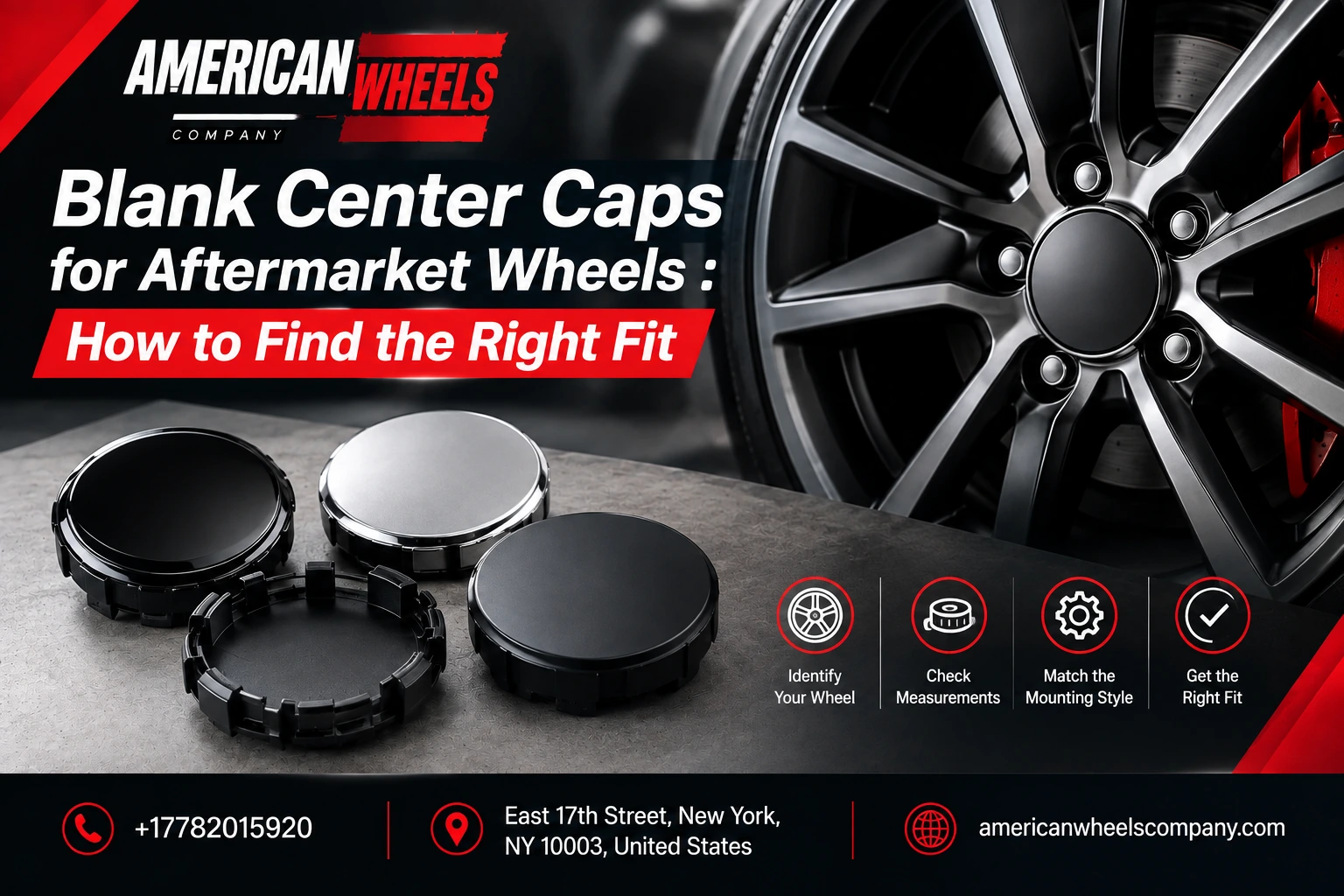
Blank center caps for aftermarket wheels are a simple way to replace missing caps and get a clean, logo-free look. But “blank” does not mean universal. To find the right fit, identify your wheel brand and model, check the part number if available, measure the cap, and confirm the rear mounting style before ordering.
The most important rule is simple: match the center cap to the wheel, not just the vehicle. Aftermarket wheels can use different cap sizes and mounting designs even when they are fitted to the same car.
If you need help finding the right replacement, American Wheels Company offers blank, no-logo, and other wheel center cap options for different applications.
How to Find the Right Blank Center Caps for Aftermarket Wheels
Finding the right cap does not have to be difficult. Follow these five steps:
Step
What to Check
Why It Matters
1
Wheel brand and model
Narrows down the correct cap
2
Part number
Can identify an exact replacement
3
Cap measurements
Confirms physical size
4
Mounting style
Makes sure the cap attaches correctly
5
Product quantity
Confirms what you are actually buying
If you still have one original cap, do not throw it away. The back of that cap can provide some of the best fitment information.
Step 1 — Identify Your Aftermarket Wheel
Before searching for a replacement, find out exactly which aftermarket wheel you have.
Your vehicle’s year, make, and model does not automatically tell you which center cap fits an aftermarket wheel. A vehicle can have different factory wheels, and aftermarket wheels can use their own cap designs. Current aftermarket center-cap guidance also recommends identifying the wheel brand and model rather than relying on vehicle information alone.
Find the Wheel Brand
Look for the wheel manufacturer’s name or logo.
You may find it:
On the front of the wheel
On the back of the spokes
Inside the wheel barrel
Near the lug holes
On a casting or stamped marking
Find the Wheel Model
The brand alone may not be enough.
One wheel manufacturer can make many wheel designs, and different models may use different center caps.
Write down the complete model name or number if you can find it.
Check the Back of the Wheel
Some aftermarket wheels have useful identification marks on the back. These may include a brand, model, part number, or other casting information.
This information becomes especially useful when the original center cap is missing.
Why Your Vehicle Model Is Not Enough
Your vehicle’s year, make, and model does not automatically tell you which center cap fits an aftermarket wheel.
A vehicle can have different factory wheels, and aftermarket wheels can use their own cap designs.
Current aftermarket fitment guides make the same point: wheel brand and model information is more useful than relying on vehicle application alone.
Step 2 — Look for the Center Cap Part Number
If you have an old center cap, turn it over and inspect the back.
You may find:
Part number
Manufacturer code
Molded numbers
Letters
Size markings
Other identification marks
Write down the complete code, including dashes or letters.
A part number can be one of the fastest ways to narrow down an exact replacement. American Wheels Company also recommends checking the complete number along with photos, size, and mounting details when identifying a cap.
What If the Part Number Is Missing?
That is not a problem.
You can still use:
Wheel brand
Wheel model
Cap measurements
Wheel opening
Backside clip design
Mounting style
Clear photos
If you only have photos, take one of the front and one of the back whenever possible.
What If All Four Caps Are Missing?
Start with the wheel itself.
Find the wheel brand and model, inspect the wheel markings, and measure the center opening. You can then compare those details with aftermarket replacement options.
Do not guess from the vehicle model or wheel diameter alone.
Step 3 — Measure the Center Cap for a Proper Fit
Measurements are important, but one measurement is rarely enough.
Depending on the cap design, you may need to compare the outer diameter, mounting diameter or clip span, depth, and attachment points.
Measure the Outer Diameter
Measure straight across the cap at its widest point.
Use millimeters (mm) because most center cap listings use metric measurements.
For example, you may see sizes such as 60mm, 68mm, or 75mm.
But remember: the advertised diameter is only part of the fitment.
American Wheels Company’s size guide also warns that two caps with the same advertised size can have different rear mounting dimensions, clips, depth, or attachment styles.
Measure the Mounting or Clip Diameter
Now inspect the back.
Depending on the design, you may need to measure the distance across the retaining clips or the mounting area that sits inside the wheel.
This measurement helps tell you whether the cap can actually lock into the wheel.
Measure the Cap Depth
Depth is easy to overlook.
A cap can have the correct front diameter but still fail to sit correctly if the depth is wrong.
A deep wheel recess may require a cap with enough depth to sit properly without interfering with parts behind the wheel.
Check the Wheel’s Center Opening
If you do not have an old cap, measure the wheel’s center opening.
Take care with this measurement because the opening and the cap’s mounting area are not always described in the same way by sellers.
The safest approach is to compare all available dimensions, not just one number. Current measurement guides also recommend checking the cap’s dimensions and attachment style rather than relying on appearance alone.
Center Bore vs Center Cap Size: Don’t Mix Them Up
This causes a lot of confusion.
Center bore is the opening in the center of the wheel.
Center cap size refers to the dimensions of the cap and its mounting area.
They are related, but they are not automatically the same measurement.
For example, a cap advertised as 68mm does not mean every 68mm cap will fit every wheel with a similar-looking opening.
The rear design may be different.
Why Can the Right-Looking Cap Still Not Fit?
Two caps can look almost identical from the front but have different:
Clip diameters
Clip positions
Retaining rings
Depths
Tabs
Mounting holes
Attachment systems
That is why the back of the cap is so important.
The front tells you what the cap looks like. The back tells you how it fits.
Step 4 — Check the Center Cap Mounting Style
Before buying aftermarket wheel center caps, check how the original cap attaches.
Snap-In or Clip-In Center Caps
These caps use clips, tabs, or a retaining ring to hold the cap in the wheel.
The clip shape and spacing matter.
Push-Through Center Caps
Push-through caps are installed from the back of the wheel.
They use a different mounting method from front-installed snap-in caps, so they should not be treated as interchangeable.
Screw-On or Bolt-On Caps
Some aftermarket wheels use screws, bolts, or other hardware to hold the center cap in place.
If your old cap uses hardware, compare the number and location of the mounting points.
Why the Back of the Cap Matters
The same front design can be made with different rear mounting systems.
So when you find a possible replacement, compare the front, back, measurements, and attachment method.
That gives you much stronger fitment evidence than a product photo alone.
Are Blank Center Caps Universal for Aftermarket Wheels?
No. A blank center cap is not automatically a universal center cap.
“Blank” describes the front of the cap. It means there is no visible logo or badge.
“Universal” describes how broadly a cap is designed to fit.
These are two different things.
You can find universal no-logo caps in different sizes and mounting styles, but you still need to compare the product’s specifications with your wheel.
If you want to see available plain and unbranded options, you can browse universal no-logo wheel cap options and compare the listed measurements before buying.
How to Match a Blank Center Cap to an Aftermarket Wheel
Once you have your information, compare the cap and wheel step by step.
Match the Wheel Brand
Start with the manufacturer’s name.
Match the Wheel Model
Make sure the cap is listed for the correct wheel series or model when that information is available.
Match the Part Number
If the number on your original cap matches the replacement listing, that is a strong fitment clue.
Match the Measurements
Compare:
Outer diameter
Mounting diameter
Clip span
Depth
Wheel opening
Do not stop after finding one matching measurement.
Match the Mounting Style
Make sure the replacement uses the same type of attachment.
Compare the Backside
Look for matching:
Clips
Tabs
Rings
Screw holes
Retaining points
Confirm the Product Quantity
Some products are sold individually while others come in multiple pieces.
Always read the product title and package details before ordering.
What If Your Aftermarket Wheel Is Discontinued?
Older aftermarket wheels can be harder to match.
The original center cap may no longer be available from the wheel manufacturer.
Search by the Wheel Model
Start with the exact wheel brand and model.
Search by the Old Part Number
If you have a part number, search the complete code rather than a general phrase.
Use Measurements When the Original Cap Is Gone
If the cap is missing, measure the wheel opening and gather as much wheel information as possible.
Clear photos can also help narrow down the design.
Consider a Blank or No-Logo Replacement
A blank cap can be a practical option when you do not need the original logo.
It can also work well if you are restoring older aftermarket wheels or want a cleaner custom look. Current AWC listings specifically include blank and no-logo caps for selected aftermarket applications.
Common Mistakes When Buying Blank Center Caps for Aftermarket Wheels
Assuming Blank Means Universal
It does not.
A blank cap can still have a very specific mounting size.
Buying by Vehicle Make and Model Only
Your vehicle information is not enough to identify many aftermarket wheel caps.
Start with the actual wheel.
Measuring Only the Front
The front diameter is useful, but the rear mounting area is just as important.
Confusing Center Bore With Cap Size
The wheel opening and the cap’s advertised diameter may describe different parts.
Check the complete dimensions.
Ignoring the Backside Clips
A cap that looks right from the front can still have the wrong clips.
Choosing From a Product Photo Alone
Photos help with appearance. They do not prove fitment.
Forgetting to Check Quantity
Make sure you know whether the listing includes one cap, two, four, or another quantity.
Blank vs Branded Center Caps for Aftermarket Wheels
Blank caps are useful when you want a clean, unbranded appearance.
Branded caps make more sense when you want to keep a wheel or vehicle logo visible.
Blank Center Caps
Branded Center Caps
No visible logo
Visible logo
Clean, simple look
Branded appearance
Good for aftermarket/custom wheels
Good for matching a branded style
Easy to customize
Keeps the original-style identity
Fitment still matters
Fitment still matters
If you are deciding between the two styles rather than simply trying to find a replacement, read the comparison on blank vs logo wheel center caps.
The important point is that blank vs branded is a style decision; fitment is a mechanical decision.
What Finish Should You Choose?
Once fitment is confirmed, choose a finish that works with your wheel.
For example:
Matte black → matte or satin wheels
Gloss black → gloss wheels
Chrome → chrome or polished accents
Silver → silver or bright-finish wheels
If you are choosing between matte and gloss black, the finish can change the entire look of the center area.
But always choose fitment before finish. A perfect color does not help if the cap does not fit.
Conclusion
Finding blank center caps for aftermarket wheels is mostly a fitment job.
Start with the wheel brand and model, look for a part number, check the measurements, inspect the backside mounting system, and then confirm the complete product specifications.
Do not choose a cap simply because it looks right or because the listing says “universal.”
Identify → Measure → Match → Verify.
Once those four steps are done, choosing the finish, logo-free style, and exact blank cap becomes much easier.
Frequently Asked Questions
Are blank center caps for aftermarket wheels universal?
No. “Blank” only means the cap has no visible logo. Aftermarket wheels can use different diameters, depths, clips, and mounting systems, so you still need to confirm fitment.
How do I know what center caps fit my aftermarket wheels?
Start with the wheel brand and model. Then check the part number, measurements, backside design, and mounting style. If you have an original cap, compare it directly with the replacement.
What size blank center cap do I need?
You need the size that matches your wheel’s actual mounting area. Check the outer diameter, mounting or clip diameter, depth, and attachment style rather than choosing only by a number such as 60mm or 68mm.
How do I measure an aftermarket wheel center cap?
If you have the old cap, measure its outer diameter and rear mounting area in millimeters. Also check its depth and clips. If the cap is missing, measure the wheel opening and use the wheel’s brand and model to narrow the search.
Can I use universal center caps on aftermarket wheels?
Yes, some universal caps fit aftermarket wheels. However, “universal” does not mean one size fits every wheel. The dimensions and mounting style still need to match.
Does wheel diameter determine center cap size?
No. A 17-inch, 18-inch, or 20-inch wheel can use different center cap sizes. Wheel diameter tells you the overall wheel size, not the exact center-cap fitment.
Can I replace branded center caps with blank ones?
Yes, as long as the blank cap fits the wheel’s mounting area. Blank caps are often used when owners want a clean, logo-free appearance on aftermarket or custom wheels.
What if I cannot find the original center cap for my aftermarket wheels?
Identify the wheel brand and model, check for markings or a part number, and measure the wheel or remaining cap. A compatible blank or no-logo replacement may also be an option when the original branded cap is unavailable.