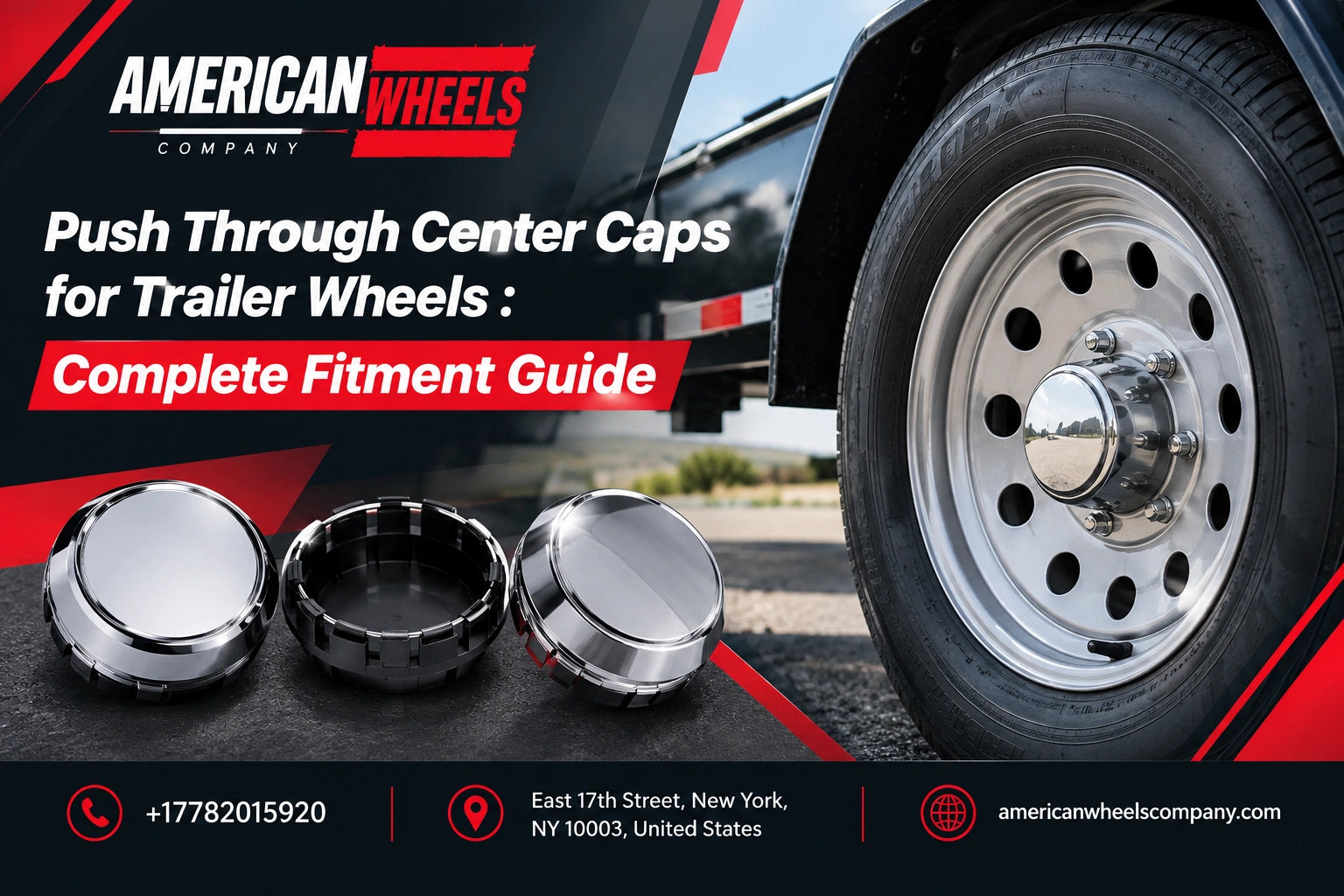
Push through center caps for trailers need to match the trailer wheel’s center bore, cap barrel diameter, height, and hub clearance. The safest way to choose the right cap is to measure the wheel opening and compare the complete cap specifications—not just the advertised size. A cap that looks right can still be the wrong fit.
If you are replacing a lost cap, upgrading trailer wheels, or trying to find the correct trailer wheel center caps, this guide covers the measurements, common sizes, open vs. closed designs, installation, and the mistakes that often lead to a poor fit.
American Wheels Company also offers push through caps in several bore sizes and styles, but fitment should always be confirmed against your actual wheel.
What Are Push Through Center Caps for Trailers?
A push through center cap is installed from the back of the wheel. Its barrel passes through the wheel’s center opening and is held in place by the fit between the cap and the wheel.
This is different from a front mounted snap in cap.
Push through caps are commonly used on:
Trailer wheels
Truck wheels
RV wheels
Aftermarket wheels
Specialty wheel and axle setups
The important part is fitment. Push through caps are size specific, so you should not assume that any trailer wheel can use the same cap.
How Do Push Through Center Caps Work?
The cap has a barrel that enters the wheel’s center opening from behind. Once seated, the retaining section holds the cap in position.
Because the cap is installed from the rear, the barrel diameter, height, and clearance behind the wheel matter just as much as the visible front of the cap.
Do not swap one style for the other simply because the front diameter looks similar.
What Measurements Do You Need for a Trailer Center Cap?
For trailer wheel center cap fitment, diameter is only the starting point.
Measurement
Why It Matters
Center bore / pilot diameter
Opening the cap must enter
Barrel diameter
Controls the fit inside the wheel
Barrel height
Determines how far the cap enters
Total cap height
Helps prevent interference
Inner clearance
Provides room around the hub
Hub clearance
Prevents contact with axle or hub parts
End style
Determines open or closed application
Part number
Helps identify an exact replacement
American Wheels Company’s current push through measurement guide also emphasizes barrel diameter, barrel height, total height, inner clearance, and end style rather than relying on one measurement alone.
Why the Barrel Matters
The barrel is the section that actually enters the wheel.
That means a cap can have the correct looking front face but still fail to fit because the barrel is:
Too large
Too small
Too short
Too long
The wrong shape
This is why measuring only the decorative face of the old cap is not enough.
How to Measure Push Through Center Caps for Trailers
If you still have the old cap, measuring it is usually easier than guessing from a product photo.
1. Remove the Old Center Cap
Remove the cap carefully so you can inspect the complete barrel and retaining area. If the wheel is mounted and the cap cannot be measured accurately, remove the wheel or have a qualified technician help.
2. Measure the Wheel Center Opening
Measure the opening where the cap sits. A digital caliper gives a more precise measurement than a basic tape measure, especially when the difference between two sizes is only a few hundredths of an inch.
3. Measure the Cap Barrel Diameter
Measure the outside diameter of the barrel that enters the wheel. This is one of the most important measurements for a push through cap.
4. Measure Barrel Height
Measure how far the barrel extends from the back of the cap. A replacement with the wrong barrel height may not seat correctly.
5. Measure Total Height
Check the cap’s overall depth from the rear mounting surface to the highest point. This helps you avoid interference behind the wheel.
6. Check Hub Clearance
Look behind the wheel. Make sure the new cap will not contact the hub, axle components, grease cap, or other hardware.
7. Check the End Style
Determine whether you need:
Open end
Closed end
Removable plug
Removable top
8. Record the Measurements
Write down the measurements before shopping. For another measurement approach, a trailer center cap guide from DewFlew recommends checking the outside diameter, inner diameter, and depth of the existing cap.
The more complete your measurements are, the less likely you are to order the wrong replacement.
Common Trailer Wheel Center Cap Sizes
Trailer wheels use several common center bore sizes. However, these are reference sizes, not a guarantee of fit.
Common Size
Approx. Metric Size
Common Search Term
2.80″
71.1 mm
2.80 trailer center caps
3.19″
81 mm
3.19 trailer wheel center caps
3.30″
83.8 mm
3.30 trailer center caps
4.25″
108 mm
4.25 trailer wheel center caps
4.28″
~109 mm
4.28 trailer center caps
4.88″
124 mm
4.88 trailer center caps
4.90″
~124.5 mm
4.90 trailer center caps
5.12″
130 mm
5.12 trailer center caps
5.15″
~131 mm
5.15 trailer center caps
Trailer Wheels currently organizes its trailer center caps by sizes including 3.19″, 3.30″, 4.25″/4.28″, 4.90″, and 5.15″, while its fitment information also connects common wheel configurations with certain center bore ranges.
But do not use lug count as your only sizing method.
For example, a 6 lug trailer wheel may commonly use a 4.25″ or 4.28″ center bore, but the actual wheel should still be measured before ordering.
How to Choose the Right Push Through Center Caps for Trailers
Once you have the measurements, compare the complete product specifications.
Match the Center Bore
Start with the wheel’s center opening. The cap needs to fit the actual opening—not simply a similar looking wheel.
Match the Barrel Diameter
The cap barrel must enter the wheel correctly. A diameter that is too small can create a loose fit. One that is too large may not enter the opening.
Check the Height
Compare barrel height and total cap height. A cap can have the correct diameter and still be too deep for the available space.
Check Hub Clearance
Make sure there is enough room behind the cap. This is especially important on trailer wheels with grease caps, EZ Lube systems, or other hardware near the center.
Confirm the End Style
Check whether your application needs an open end, closed end, or removable plug.
Check the Wheel Application
Wheel size, lug pattern, wheel brand, and wheel model can help confirm fitment, but they should not replace actual measurements.
For example, etrailer lists a trailer cap designed for a 4.25″–4.27″ pilot hole, with a removable plug for EZ Lube axle access. Its listing also specifies wheel size, lug configuration, depth, and quantity.
That is a good example of why you should compare several specifications together, rather than shopping by one number.
Open End vs. Closed End Trailer Center Caps
The choice between open and closed designs depends mainly on what is behind the wheel.
What Is an Open End Center Cap?
An open end cap leaves the center accessible. This can be useful when the wheel setup needs access to a manual hub or other center component.
Open end designs are also available for some trailer applications.
What Is a Closed End Center Cap?
A closed end cap covers the center completely. It can give the wheel a more finished appearance when there is no need for access through the center.
What About Removable Plugs?
Some trailer caps combine a covered appearance with a removable center plug.
This can be useful when you need access to an EZ Lube axle without removing the entire cap. Current trailer cap listings from etrailer and Trailer Wheels show this type of removable plug design. For a deeper comparison, see the differences between open and closed center cap designs.
Open vs. Closed: Quick Comparison
Feature
Open End
Closed End
Center access
Yes
No
Center coverage
Partial
Full
Manual hub access
Useful when required
May block access
Appearance
Functional/open
Fully covered
Removable plug
Some models
Some models
Best choice
When access is needed
When full coverage is needed
Do not assume open is better or closed is better. Match the original wheel and hub setup.
Stainless Steel vs. Chrome vs. Aluminum Trailer Center Caps
Material affects appearance, corrosion resistance, weight, and the overall construction of the cap.
Material
Main Benefit
Consideration
Stainless steel
Good corrosion resistance
Metal construction
Chrome plated steel
Bright finish
Finish can change with use
Aluminum
Lightweight
Finish and design vary
Plastic/ABS
Lightweight
Application specific durability
For trailer use, stainless steel is a common choice, especially where exposure to moisture is a concern. Current trailer cap listings include stainless steel, chrome plated steel, plastic, and black finishes.
Still, fitment should come before finish. A beautiful cap that does not fit the wheel is not a good replacement.
How to Install Push Through Center Caps on Trailer Wheels
Push through caps are installed from the back of the wheel.
Before Installation
Check:
Correct bore size
Correct barrel diameter
Correct height
Correct end style
Hub clearance
Cap condition
Clean the wheel opening before installing the cap.
Push the Cap Through From the Back
Position the cap evenly against the wheel opening and press it through from the rear. Do not force a cap that does not fit. If excessive force is needed, stop and recheck the measurements.
Check the Front Seating
Once installed, check that:
The cap sits evenly
It is not tilted
The retaining section is seated
Nothing behind the cap is touching
The cap does not move excessively
A correct fit should not depend on forcing the cap into an undersized opening.
Why Do Trailer Center Caps Keep Falling Off?
If a trailer center cap keeps coming loose, fitment should be one of the first things you check.
Wrong Center Bore
A cap that is too small may not hold securely.
Wrong Barrel Diameter
The front face may look correct while the barrel does not properly engage the wheel.
Incorrect Height
A cap that does not seat to the correct depth can have poor retention.
Damaged Wheel Opening
A worn or damaged retaining area can prevent a properly sized cap from staying secure.
Incorrect Installation
A cap that is not fully seated can loosen during use.
Wrong Cap Type
A push through cap should not be replaced with a different mounting style simply because the front looks similar.
Common Mistakes When Buying Trailer Push Through Center Caps
Buying by Trailer Model Alone
Your trailer model can help, but it does not replace measuring the wheel. Different wheels can use different center openings.
Using Wheel Diameter as the Cap Size
A 15 inch or 16 inch wheel does not tell you the center cap size. The wheel diameter and center bore are different measurements.
Measuring Only the Front of the Cap
The rear barrel is what enters the wheel. Always inspect and measure the mounting section.
Ignoring Barrel Height
Diameter is not enough. Height and depth can affect whether the cap seats correctly.
Ignoring Hub Clearance
The cap may fit the wheel opening but still hit something behind the wheel.
Assuming 4.25″ Means Every 4.25″ Application Is Identical
Small dimensional differences matter. For example, etrailer specifies some trailer caps for a 4.25″–4.27″ pilot range, showing why the exact product specification matters.
Choosing by Product Photo
Two caps can look nearly identical from the front and have different barrels, heights, or mounting systems.
Assuming the Product Quantity
Check whether the listing contains:
1 cap
2 caps
4 caps
Cap plus plug
Cap plus hardware
Do not assume quantity from the product image.
Final Thoughts
The right push through center caps for trailers are not chosen by appearance alone. Start with the wheel’s center opening, then confirm the barrel diameter, height, hub clearance, end style, and other product specifications.
Common sizes such as 3.19″, 3.30″, 4.25″, 4.28″, 4.90″, and 5.15″ can help narrow your search, but the actual wheel measurement should make the final decision.
What size push through center caps do trailer wheels use?
Common trailer center cap sizes include 3.19″, 3.30″, 4.25″, 4.28″, 4.90″, 5.12″, and 5.15″, but the correct size depends on the actual wheel center opening and cap dimensions.
How do I measure a trailer wheel for a center cap?
Measure the wheel’s center opening and, if possible, measure the old cap’s barrel diameter, barrel height, total height, and clearance. A digital caliper can give a more precise measurement than a ruler.
What is the most common trailer wheel center cap size?
There is no single size that fits all trailer wheels. Common listings include 3.19″, 3.30″, 4.25″/4.28″, 4.90″, and 5.15″ applications.
Do push through center caps fit all trailer wheels?
No. Push through center caps are size specific. The wheel’s center bore, cap barrel, height, hub clearance, and mounting design must match.
What is the difference between open and closed trailer center caps?
An open end cap leaves the center accessible, while a closed end cap covers it. Open designs can be useful when the wheel requires hub access. Closed designs provide full center coverage.
Can I use a 4.25 inch center cap on any 4.25 inch trailer wheel?
Not automatically. You should compare the exact pilot/bore range, barrel dimensions, height, hub clearance, and end style. Some products are designed for a 4.25″–4.27″ pilot range, for example.
How do push through center caps install?
They are installed through the wheel’s center opening from the back. The cap is pushed into the wheel until the retaining section seats securely.
Why does my trailer center cap keep falling off?
Common causes include incorrect bore or barrel size, poor seating, damaged retaining areas, incorrect installation, or using the wrong cap style. Recheck the complete fitment rather than simply replacing the cap with another similar looking model.
Do EZ Lube trailer wheels need a center cap with a plug?
Not every EZ Lube setup uses the same cap, but some trailer center caps include removable plugs that provide access to the EZ Lube axle. Check the axle and cap specifications before buying.