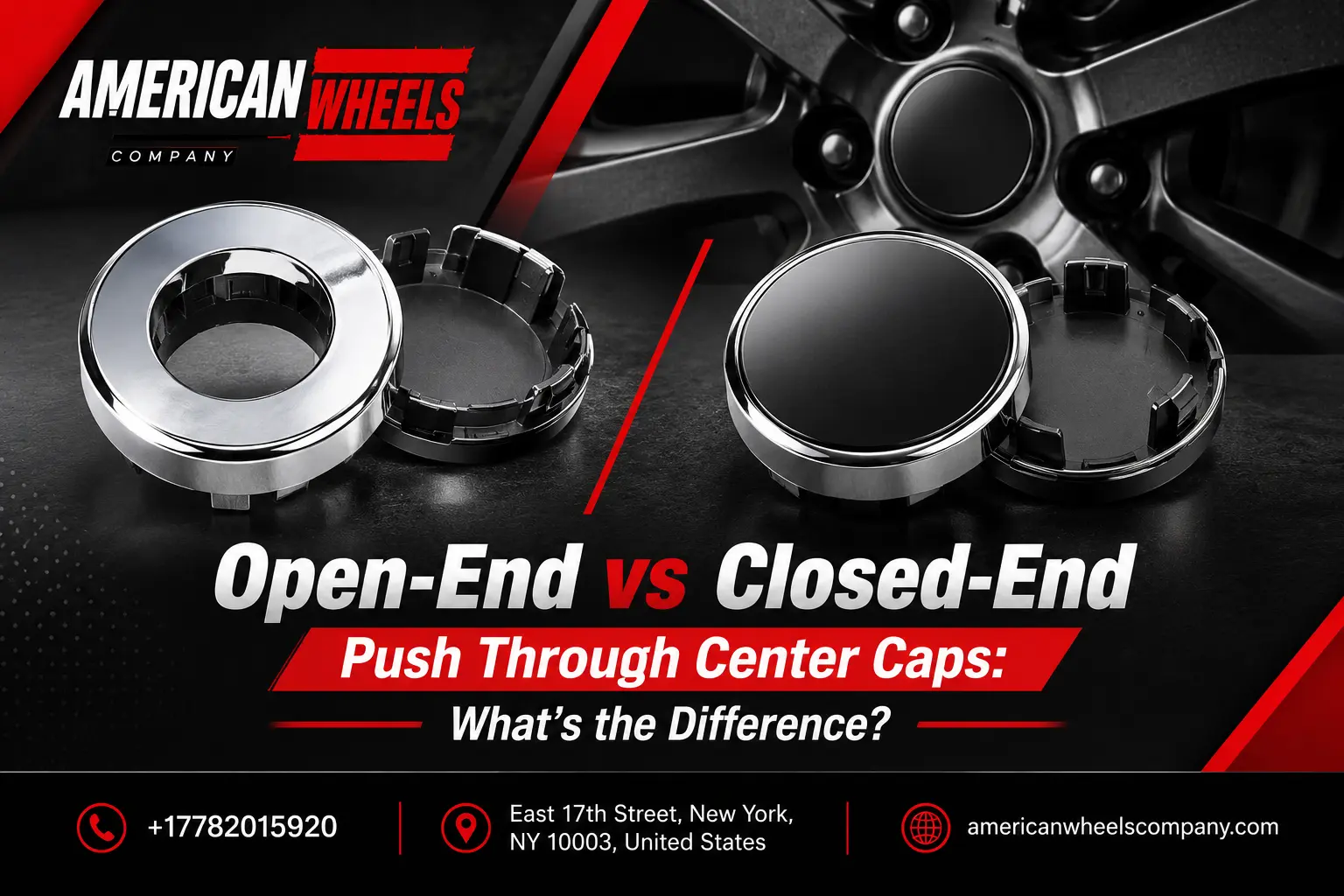
Open end vs closed end center caps mainly comes down to one thing: access vs coverage. Open-end push-through center caps leave the center area accessible, which is useful when you need access to a manual locking hub. Closed-end caps cover the center for a cleaner, more complete finish. The right choice depends on your wheel and hub setup—not simply whether the cap goes on the front or rear.
If you are replacing a missing cap, upgrading your wheels, or trying to figure out why one cap has an opening and another does not, this guide will make the choice much easier.
Open-End vs Closed-End Center Caps at a Glance
Feature
Open-End Center Caps
Closed-End Center Caps
Center design
Center remains open
Center is covered
Main purpose
Allows hub access
Provides full center coverage
Manual 4WD hub
Often useful
Can block access
Appearance
Open center
More complete finish
Dirt/debris coverage
Less center coverage
More center coverage
Best for
Wheels needing hub access
Wheels that do not need hub access
Installation
Pushes through from the back
Pushes through from the back
The simple rule: If you need access to the hub, an open-end push-through center cap is often the better choice. If you do not need hub access and want the center covered, a closed-end push-through center cap is usually the better fit.
However, always confirm your wheel and hub specifications before buying.
What Is an Open-End Push-Through Center Cap?
An open-end center cap has an opening through the middle. Unlike a closed cap, it does not completely cover the hub area.
This design is useful when something behind the wheel needs to remain accessible.
When Are Open-End Center Caps Used?
Open-ended center caps are commonly used when the wheel needs access to a manual locking hub.
This is especially important on some 4WD vehicles. The hub may need to be reached without removing the entire wheel center cap.
For this reason, open end center caps are often found on certain:
4WD vehicles
Trucks
RVs
Trailer wheels
Specialty wheel and axle setups
The exact application varies, so an open cap should not be chosen just because the vehicle is a truck or 4WD.
For example, Wheel Pros states that open-end center caps can be used with manual 4WD hubs, while most of its wheels come with closed-end caps.
Why Choose an Open-End Cap?
The biggest benefit is easy hub access.
If your wheel has a manual locking hub that needs to be operated or serviced, a closed center cap could get in the way.
An open-ended push-through center cap solves that problem while still giving the wheel a finished center-cap design.
What Is a Closed-End Push-Through Center Cap?
A closed-end center cap has a solid center. Once installed, it covers the hub area rather than leaving it exposed.
This is the more suitable design when there is no need to access a manual hub through the center of the wheel.
Why Use a Closed-End Center Cap?
Closed-end caps offer:
Full center coverage
A cleaner appearance
Better coverage around the center area
Less exposed hub area
A finished look for many wheel applications
They are common on many standard wheel setups.
That does not mean every vehicle should use a closed cap. The wheel’s center opening, hub design, and required clearance still matter.
Open-End vs Closed-End Center Caps: Key Differences
1. Hub Access
This is the biggest difference.
Open-end: The center remains accessible.
Closed-end: The center is covered.
If you have a manual locking hub that must be accessed through the wheel, an open-end design may be required.
2. Center Coverage
Closed-end center caps cover the center opening completely.
Open-end caps leave the center area exposed.
So if your priority is a covered and finished center, a closed-end cap makes more sense—provided your wheel is designed for it.
3. Appearance
A closed-end cap usually creates a more complete look because there is no visible opening through the middle.
An open-end cap has a more functional appearance because the center remains accessible.
Neither style is automatically better. It depends on what your wheel needs.
4. Installation
Both styles are push-through center caps. They install through the wheel’s center opening rather than snapping onto the front face like a typical snap-on cap.
The important difference is the end design, not the basic installation direction.
If you are unsure how this style differs from other caps, see our guide to push-through wheel center caps for a closer look at how they work.
5. Maintenance and Access
An open-end cap makes it easier to reach a hub when the wheel setup requires it.
A closed-end cap gives you more complete coverage but needs to be removed if the covered hub must be accessed.
Which One Should You Use?
Choosing between open end center caps and closed end center caps is easier when you start with the wheel—not the vehicle name.
Choose an Open-End Center Cap If:
Your wheel requires manual hub access
You have a manual 4WD locking hub
The original cap was open-ended
Your wheel manufacturer specifies an open design
You need regular access to the hub
Your axle or wheel setup requires center access
Choose a Closed-End Center Cap If:
Your wheel does not need hub access
The original cap was closed-ended
You want full center coverage
Your wheel manufacturer specifies a closed design
You want a more complete center appearance
Important: Do not assume that all front wheels need open caps or that all rear wheels need closed caps. That is not a reliable fitment rule.
The wheel and hub configuration should always make the final decision.
Can You Use an Open-End Cap Instead of a Closed-End Cap?
Not automatically. Both may be push-through center caps, but that does not mean they are interchangeable.
The wheel still needs the correct:
Center bore
Mounting diameter
Barrel diameter
Barrel height
Overall cap depth
Hub clearance
Retaining design
Open or closed end
For example, a cap may have the correct diameter but still be too deep for the wheel or interfere with the hub.
This is why measuring your wheel before ordering is so important.
How to Check Which Push-Through Center Cap You Need
Before buying an open end or closed end center cap, check the actual wheel.
1. Measure the Center Opening
Start with the wheel’s center opening.
A small measurement error can result in a cap that does not fit securely.
2. Check the Cap’s Mounting Diameter
The outside diameter is not the only measurement that matters.
The part of the cap that sits inside the wheel must match the wheel’s center opening.
3. Check the Barrel Height
The cap needs enough depth to sit correctly without hitting components behind the wheel.
A cap that is too shallow or too deep can create fitment problems.
4. Check Hub Clearance
This is especially important for open-ended center caps.
If your wheel has a protruding manual hub, make sure the cap provides enough room for it.
5. Confirm the End Style
Check whether your original cap is:
Open end
Closed end
Open end with removable plug
Closed end with removable section
Some center caps use removable plugs or tops, so visually inspecting the original cap can help.
Open vs Closed Center Caps for Trucks, Trailers and RVs
Trucks
Trucks can use either open-end or closed-end center caps.
The deciding factor is the wheel and hub setup. A truck with manual locking hubs may need an open center, while another truck may use a closed design.
Trailers
Trailer wheels also come in both styles.
Trailer-Wheels, for example, lists both open-end and closed-end trailer wheel center caps in several sizes, including 2.95-inch, 3.19-inch, 3.30-inch, 4.25-inch and larger applications.
Some trailer center caps also use removable plugs for specific axle applications.
RVs
RV applications can vary widely.
Some wheels need center access, while others simply need a covered center cap. Always match the cap to the wheel and axle specifications instead of choosing based only on the RV model.
4WD Vehicles
This is where the difference becomes especially important.
If the wheel covers a manual locking hub, an open-ended design may allow the hub to remain accessible.
If there is no need for that access, a closed-end cap may be appropriate.
Common Mistakes When Buying Open or Closed Center Caps
Choosing Only by Diameter
A matching diameter does not guarantee proper fitment.
Depth, barrel size, mounting design, and hub clearance can also matter.
Assuming Every Front Wheel Needs an Open Cap
This is one of the most common mistakes.
Open-end caps are often associated with front 4WD applications because of manual hubs, but front wheel does not automatically mean open end.
Assuming Every Rear Wheel Needs a Closed Cap
The same rule applies to rear wheels.
The correct cap depends on the actual wheel and hub configuration.
Buying Only by Vehicle Model
A vehicle model can have multiple wheel designs.
Aftermarket wheels can also use different center-cap sizes from the original wheels.
Always check the wheel itself.
Ignoring Barrel Height
Two caps can have similar diameters but different depths.
If the barrel is wrong, the cap may not seat correctly.
Assuming Push-Through Caps Are Universal
Push-through does not mean universal.
Different wheels use different center openings and mounting dimensions.
If you are comparing installation styles, our guide on push-through and snap-on cap differences explains why these two styles should not be treated as interchangeable.
Open-End vs Closed-End Center Caps: Quick Buying Guide
If You Need…
Better Choice
Access to a manual locking hub
Open-end
Full center coverage
Closed-end
Frequent hub access
Open-end
A covered center
Closed-end
Manual 4WD hub access
Open-end, if specified
No hub access
Closed-end, if specified
Replacement for an existing open cap
Match the original specification
Replacement for an existing closed cap
Match the original specification
Best overall fit
Whichever matches your wheel and hub
The safest approach is simple: match the replacement cap to the wheel’s measurements and hub requirements.
Final Verdict: Open End vs Closed End Center Caps?
The difference between open end vs closed end center caps is simple once you know what the center needs to do.
If your wheel needs access to a manual locking hub, an open-end push-through cap is often the right choice. If there is no need for hub access and you want the center fully covered, a closed-end cap is usually the better option.
But do not buy based on appearance or vehicle type alone. Measure the wheel, check the hub, and match the cap specifications.
When you are ready to compare replacement options, American Wheels Company offers wheel center-cap solutions for different wheel designs and fitment needs.
Frequently Asked Questions
What is the difference between open-end and closed-end center caps?
Open-end center caps have an opening through the middle, while closed-end center caps cover the center completely. Open-end caps are useful when hub access is required. Closed-end caps are better when full center coverage is needed.
Are open-end center caps better than closed-end center caps?
Neither is always better. Open-end caps are better when you need access to a manual hub. Closed-end caps are better when you want the center covered and your wheel does not require hub access.
Why do some 4WD wheels use open-end center caps?
Some 4WD vehicles use manual locking hubs that need to be accessed through the center of the wheel. An open-ended cap allows that access without removing the entire wheel.
Can I use a closed-end cap on a wheel with a locking hub?
Not if the closed cap blocks access that the hub requires. Check your vehicle and wheel specifications before switching from an open-end to a closed-end design.
Are open-end center caps only used on front wheels?
No. Open-end caps are commonly associated with certain front-wheel 4WD applications because of manual hubs, but they are not limited to front wheels. The wheel and hub setup determine the correct style.
Do open and closed push-through center caps fit the same wheel?
Not necessarily. Both may use the same push-through installation method, but the correct end style, dimensions, depth, and hub clearance still need to match the wheel.
How do I know which push-through center cap I need?
Measure the wheel’s center opening and check the cap’s mounting diameter, barrel height, depth, and hub clearance. Then confirm whether your application requires an open or closed end.